



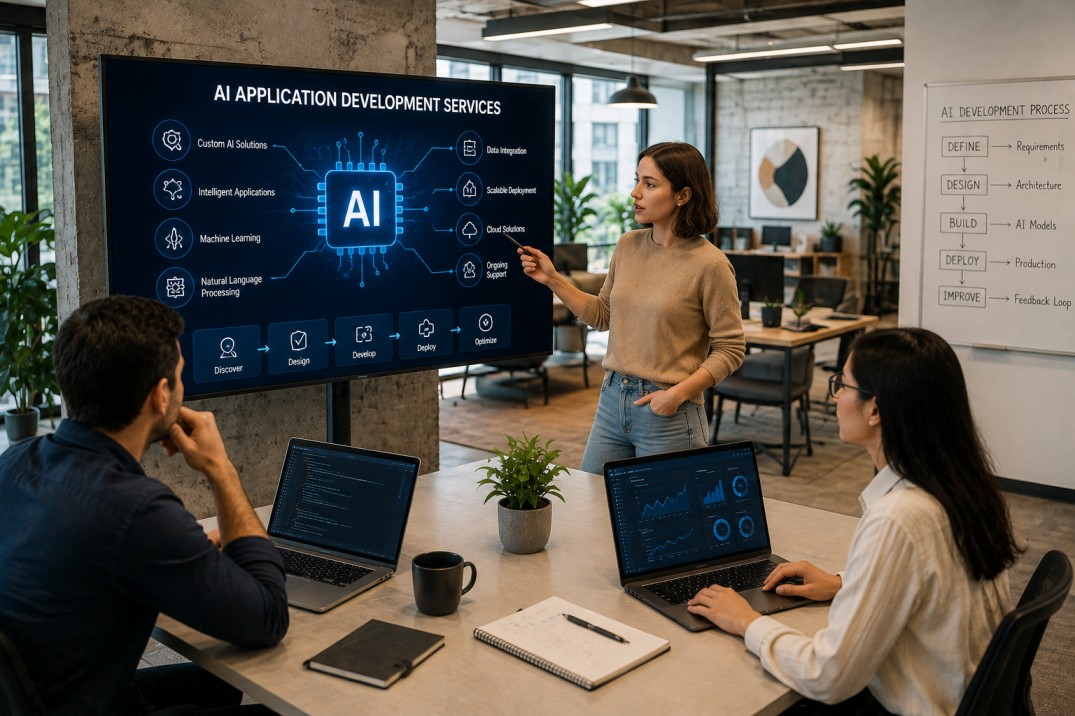
Businesses across the United States are moving beyond basic automation and experimenting with intelligent applications that can understand data, assist employees, personalize customer interactions, and support operational decisions. However, successful AI adoption requires more than adding an AI Application Development Services
The process of designing, developing, integrating, deploying, and continuously improving software applications that use artificial intelligence to solve specific business problems. These applications can combine technologies such as machine learning, natural language processing, large language models (LLMs), computer vision, predictive analytics, retrieval-augmented generation (RAG), and intelligent automation.
The objective is not simply to add AI to software. The objective is to create an application where AI performs a useful business function, connects with relevant data and systems, and produces measurable outcomes.
Many organizations already use standalone AI tools, but generic tools cannot always understand internal workflows, proprietary information, business rules, or customer-specific requirements.
A purpose-built AI application can connect intelligence directly to the workflow where it is needed.
For example:
This approach turns AI from an isolated tool into a functional part of the business application.
Research from IBM highlights customer service, data analysis, document processing, workflow automation, fraud detection, and IT operations among common enterprise AI use cases.
AI applications can take different forms depending on the business problem, available data, and desired outcome.
These applications help employees retrieve information, summarize documents, draft responses, answer questions, or complete routine tasks.
Businesses can build intelligent chat interfaces, recommendation engines, personalized search, and conversational customer support.
Machine learning models can analyze historical data to support forecasting, risk assessment, demand planning, and anomaly detection.
AI can extract information from invoices, contracts, forms, reports, and other unstructured documents and convert it into structured business data.
Organizations can use image and video analysis for quality inspection, object detection, monitoring, and visual classification.
AI applications can connect employees with internal policies, documentation, databases, and business knowledge through natural-language interfaces.
A successful AI application requires a structured development process. A practical 7-step approach includes:
The first step is identifying the business problem, current workflow, expected users, available data, existing systems, and measurable KPIs.
The team should determine whether AI is actually appropriate for the problem instead of forcing AI into a process where traditional software would be more effective.
Relevant data sources are identified and evaluated for quality, availability, privacy, structure, and accessibility.
This stage can include databases, APIs, documents, CRM platforms, ERP systems, cloud storage, and internal knowledge repositories.
The development team selects the appropriate architecture and AI technology.
Depending on the use case, this may involve:
Model selection should consider accuracy, latency, cost, security, scalability, explainability, and business requirements rather than choosing a model simply because it is popular.
AI capabilities are integrated into the application layer, business logic, APIs, databases, and user interface.
For knowledge-intensive applications, RAG can connect an LLM with company-specific information. AWS describes RAG as a technique that augments an LLM with external data, including internal business documents, with vector databases commonly used to store embeddings for retrieval.
Testing should cover both conventional software functionality and AI-specific behavior.
Teams can evaluate:
The application is deployed into the appropriate cloud or enterprise environment and integrated with existing business systems.
APIs, authentication, monitoring, logging, data pipelines, and access controls are configured before production use.
AI applications require ongoing observation because data, user behavior, models, and business requirements change over time.
Monitoring can track model performance, response quality, latency, usage, costs, security events, and unexpected behavior.
This lifecycle-oriented approach helps organizations build applications that can evolve instead of becoming isolated AI experiments.
Off-the-shelf AI tools can be useful when a business needs a general-purpose capability quickly. They may work well for basic writing, summarization, productivity, or general information retrieval.
A custom application becomes more appropriate when the business needs deeper integration, proprietary data access, specialized workflows, or greater control.
| Requirement | Off-the-Shelf AI Tool | Custom AI Application |
| General-purpose tasks | Strong fit | May be unnecessary |
| Proprietary business data | Limited | Strong fit |
| Complex workflows | Limited | Strong fit |
| Existing system integration | Varies | Designed specifically |
| Custom business rules | Limited | High control |
| Specialized user experience | Limited | Fully customizable |
| Enterprise governance | Depends on provider | Can be designed around requirements |
| Long-term scalability | Provider dependent | Architecture-driven |
The right choice depends on the problem. Custom development should be justified by business requirements rather than treated as the default option.
A custom solution may be appropriate when:
For a simple general-purpose task, an existing tool may be more economical. For a strategic workflow that depends on proprietary data and deep integration, custom development can provide greater control.
Modern AI applications are usually built as a combination of application engineering, data infrastructure, and AI components.
LLMs provide natural-language capabilities for applications such as assistants, document analysis, content generation, summarization, and conversational search.
RAG allows applications to retrieve relevant information from trusted business sources before generating a response. This is useful when the application needs current or organization-specific knowledge.
Vector databases store numerical representations of information called embeddings and support similarity-based retrieval. They are commonly used as part of RAG architectures.
Different tasks require different models. Selection should consider quality, inference cost, response speed, privacy requirements, context length, and deployment constraints.
Production AI systems need monitoring for model performance, data changes, response quality, latency, cost, security events, and abnormal behavior.
These components should be selected according to the application rather than added simply because they are associated with modern AI architecture.
Security cannot be treated as a final development step.
A business AI application may process customer information, financial records, employee data, intellectual property, or other sensitive information. Its architecture therefore needs appropriate controls from the beginning.
Important safeguards include:
NIST’s AI Risk Management Framework emphasizes trustworthy AI characteristics including validity and reliability, safety, security and resilience, accountability and transparency, explainability, privacy, and fairness. Its framework organizes risk management around Govern, Map, Measure, and Manage.
This makes governance a continuous part of the AI lifecycle rather than a one-time compliance exercise.
The most useful way to evaluate an AI opportunity is to connect the industry → application → outcome.
Industry: Healthcare
Application: AI-powered documentation and administrative assistance
Outcome: Staff can spend less time organizing repetitive information and more time on higher-value activities.
Healthcare organizations are exploring AI for administrative efficiency, clinical productivity, patient engagement, and other workflows, while governance and risk management remain important considerations.
Industry: Financial Services
Application: AI document analysis and anomaly detection
Outcome: Teams can identify relevant information faster and prioritize transactions or cases that require human review.
Industry: Retail
Application: AI recommendation and customer-service application
Outcome: Customers receive more relevant product assistance while employees gain tools for handling repetitive inquiries.
Retail organizations are already exploring generative AI for internal operations and customer experiences, including conversational shopping assistants.
Industry: Manufacturing
Application: Predictive maintenance and quality inspection
Outcome: Maintenance teams can identify potential equipment problems earlier and quality teams can detect production issues more efficiently.
IBM identifies predictive maintenance, quality assurance, inventory management, and production optimization as AI applications relevant to manufacturing.
Industry: Logistics
Application: AI demand forecasting and route-support applications
Outcome: Operations teams can use data-driven predictions to improve planning and respond to changing supply conditions.
A distinctive development framework should connect business objectives with technical execution rather than treating application development as only a coding exercise.
Zoondia can structure an AI application initiative around six practical stages:
1. Business Context
Define the business problem, users, constraints, and expected outcome.
2. AI Opportunity Mapping
Identify where AI can create measurable value and determine whether AI is the right solution.
3. Data and Architecture Design
Assess data readiness and design the application architecture, integrations, model strategy, and retrieval layer where required.
4. Build and Validate
Develop the application, integrate AI capabilities, test functionality, and evaluate model performance.
5. Secure and Operationalize
Implement access controls, privacy safeguards, monitoring, governance, and production deployment processes.
6. Measure and Evolve
Track KPIs, user feedback, model performance, cost, and business outcomes, then improve the application based on real-world usage.
This framework differentiates the approach from simply selecting an AI model and embedding it into software. It begins with the business problem and continues through measurable operational performance.
Zoondia AI Development Services
AI software development focuses broadly on using artificial intelligence throughout the software development lifecycle. AI product development focuses on building intelligent digital products and improving their product lifecycle.
This article takes a different angle: the application itself as the business solution.
The focus is on how an organization can:
This makes the discussion more focused on AI application architecture, implementation decisions, governance, and business use cases rather than general AI software development or product development.
A successful AI application is not measured by how advanced its model appears. It is measured by whether the application solves a real problem reliably and safely.
Organizations should therefore evaluate an AI initiative through questions such as:
This approach reduces unnecessary complexity and creates a clearer path from experimentation to production.
AI applications are becoming practical tools for organizations that want to improve specific workflows, enhance decision-making, and create more intelligent digital experiences. The strongest implementations begin with a defined business problem and then connect the right data, models, application architecture, security controls, and human oversight around that problem.
AI Application Development Services should therefore be viewed as a complete lifecycle—from opportunity identification and architecture through development, deployment, monitoring, and continuous improvement.
For organizations evaluating custom AI applications, the priority should not be adopting the most advanced technology available. It should be building the right technology for the right business problem, with measurable outcomes and responsible controls.
They involve designing, developing, deploying, and maintaining software applications that use AI technologies such as machine learning, LLMs, NLP, computer vision, predictive analytics, or RAG to solve specific business problems.
A custom application is worth considering when existing tools cannot support your proprietary data, specialized workflow, enterprise integrations, security requirements, or desired user experience.
Retrieval-Augmented Generation connects an AI model with external knowledge sources. The system retrieves relevant information before generating a response, making it useful for applications that need organization-specific or frequently updated information.
For many business-critical applications, human oversight is an important part of responsible deployment. The appropriate level depends on the application's risk, users, data, and consequences of incorrect output. NIST specifically addresses human roles and oversight as part of AI risk management.
Monitoring can cover model accuracy, response quality, latency, usage, cost, data changes, security events, and unexpected behavior. Regular evaluation helps identify when an AI application needs adjustment.
Yes. AI applications can connect with existing databases, APIs, CRM platforms, ERP systems, document repositories, cloud services, and other enterprise systems when the architecture and security requirements support those integrations.