



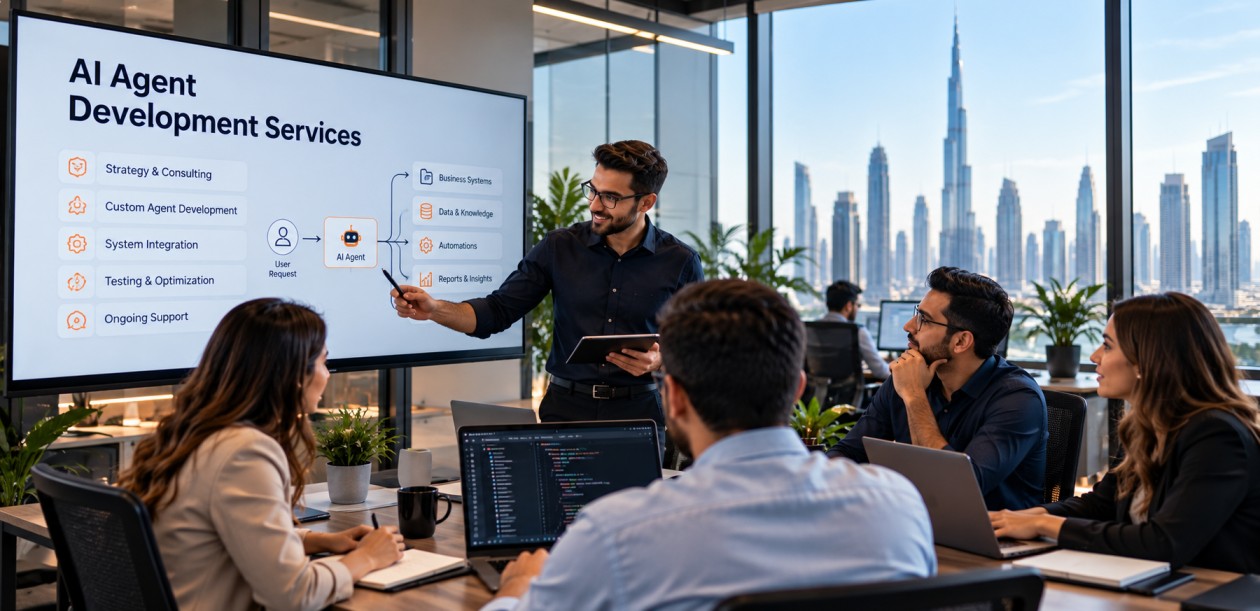
AI Agent Development Services enable organizations to build intelligent, reliable, and salable workflows.
AI Agent Development Services can help organizations turn these capabilities into controlled business workflows. The right approach begins with the business problem. Teams using Custom software development should define what the agent needs to accomplish, which systems it can access, what decisions require human approval, and how outcomes will be monitored.
What are AI agents?
An AI agent is a software system designed to pursue a defined goal by using available context, reasoning capabilities, tools, and instructions. The key distinction is action. A conventional conversational interface may provide an answer, while an agent can execute a permitted workflow.
Where can AI agents add business value?
Practical applications depend on the workflow and systems involved.
Customer support agents that classify requests and retrieve relevant information
Internal knowledge agents that search approved business content
Document-processing agents that extract and organize information
Sales assistants that prepare context for follow-up activities
Operations agents that coordinate tasks across applications
Software engineering agents that support defined development workflows
Custom AI agent development is most useful when the workflow requires business-specific rules, data, permissions, or integration. A generic agent may demonstrate a concept quickly, but production use usually requires stronger controls and clearer boundaries.
What Does AI Agent Development Services Architecture Include?
Architecture: Artificial intelligence architecture includes the model, prompts, memory, retrieval, tools, APIs, authentication, guardrails, logging, and evaluation.
Task-Based Design: AI Agent Development Services can use a single agent for simple workflows, while complex processes may require multiple specialized agents working together.
can use multiple specialized agents.
Integration: AI agents can connect with CRM platforms, databases, APIs, and enterprise applications.
Access Control: Permissions, approvals, validation rules, and audit logs help control agent actions.
Governance: Clear ownership, escalation paths, data boundaries, and evaluation criteria support accountability
How should businesses approach agent implementation?
What makes an agent ready for production?
AI Agent Development Services should consider reliability beyond the quality of generated text. Production readiness includes predictable tool behavior, access controls, serviceability, error handling, evaluation, and a defined process for human escalation.
AI agent solutions should clearly define permitted data access and authorized actions. Sensitive or consequential workflows may require approval before an action is completed.
When should businesses use custom agents?
Custom AI agent development makes sense when off-the-shelf automation cannot adequately represent the organization’s workflow. Factors include specialized Product engineering considers business rules, proprietary information, multiple system integration, role-based permissions, and requirements for human oversight.
he objective is not to make an agent autonomous at any cost. Swell-designed workflows work best when autonomy is assigned where it is useful while keeping people involved where judgment, approval, or accountability matters.
How does Zoondia approach AI agent projects?
Conclusion
Effective AI agents combine useful workflows, controlled access, reliable integration, and measurable outcomes. AI Agent Development Services can help businesses identify suitable use cases, connect agents with existing systems, and build solutions aligned with their operational needs. Zoondia can support businesses in exploring and implementing practical AI agent solutions
AI agents automate workflows using models, tools, and context.
It builds agents around specific business workflows and data.
They connect agents with approved systems, APIs, and databases
Define workflows, permissions, oversight, monitoring, and risks.
Agents automate tasks, while humans retain critical oversight.