



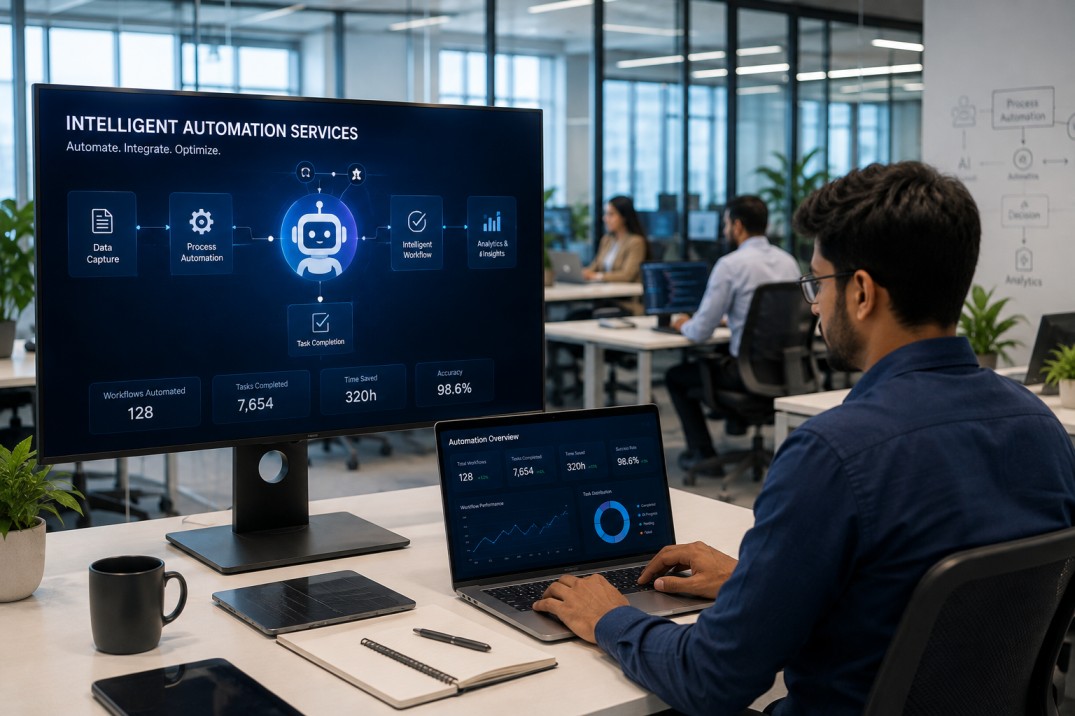
Businesses across the United States are increasingly adopting artificial intelligence and automation to improve productivity, reduce repetitive workloads, and create scalable digital operations. As companies manage growing amounts of data and increasingly complex workflows, Intelligent Automation Services are becoming an important part of modern business transformation.
From workflow automation and document processing to customer service and operational management, intelligent automation enables organizations to connect technology with everyday business processes. Companies can reduce manual effort, improve accuracy, accelerate operations, and allow employees to focus on strategic responsibilities.
An experienced automation technology partner can help businesses identify suitable automation opportunities, integrate intelligent systems, and develop scalable solutions that align with long-term business objectives.
Modern organizations handle thousands of tasks every day. Data entry, document processing, approvals, customer inquiries, reporting, and administrative activities can consume significant employee time when performed manually.
Intelligent Automation Services combine artificial intelligence, machine learning, robotic process automation, and workflow technologies to make these processes faster and more efficient.
Businesses are using intelligent automation to:
Organizations implementing Intelligent Automation Services can create connected workflows that reduce operational delays and improve overall productivity.
Companies no longer want automation systems that operate independently from their existing technology. They expect intelligent solutions to work with CRM platforms, ERP systems, databases, cloud applications, communication tools, and internal business software.
A reliable automation provider should deliver secure, scalable, and customized technologies that address specific operational challenges.
Complex business processes often involve multiple employees, departments, applications, and approval stages. Intelligent Automation Services can connect these activities through automated workflows.
Automated systems can manage notifications, approvals, task assignments, data transfers, reporting, and other repetitive activities, creating more consistent and efficient processes.
Traditional automation generally follows predefined rules. Intelligent automation combines these capabilities with AI to handle processes that involve unstructured information and changing conditions.
AI-powered systems can classify information, recognize patterns, process documents, generate responses, and support employees with operational decisions.
Businesses regularly process invoices, contracts, forms, applications, reports, and other documents. Manually extracting and organizing information from these documents can be time-consuming.
Intelligent Automation Services can use AI-powered document processing to extract, classify, validate, and organize information, helping organizations improve processing speed and accuracy.
Automation becomes more valuable when it connects existing business applications. Intelligent automation can integrate CRM, ERP, databases, cloud platforms, and other enterprise technologies.
Connected systems reduce information silos and allow data to move more efficiently between business processes.
As organizations grow, automation platforms must support increasing workloads and users. Scalable infrastructure allows businesses to expand automation capabilities while maintaining system performance and security.
Digital transformation has evolved beyond cloud migration and conventional software modernization. Businesses increasingly require systems that can understand information, automate processes, and support employees in real time.
Intelligent Automation Services can help organizations modernize existing operations by combining AI capabilities with automated workflows and enterprise applications.
Intelligent automation can support digital transformation by:
Businesses that integrate Intelligent Automation Services into their digital strategies can create more flexible operational environments capable of adapting to changing market requirements.
Intelligent automation is being adopted across many industries in the United States. Each sector can apply automation differently depending on its workflows, customer requirements, data environment, and operational challenges.
Healthcare organizations can use Intelligent Automation Services for appointment scheduling, administrative documentation, patient communication, claims processing, and data management.
Automating repetitive administrative activities can help healthcare teams reduce workloads and improve operational efficiency.
Financial organizations can use intelligent automation for document processing, reporting, transaction workflows, customer support, invoice processing, and compliance-related activities.
Automated processes can improve consistency and reduce the time required for repetitive financial operations.
Retail companies can implement automation for order processing, inventory workflows, customer support, product information management, and operational reporting.
Intelligent systems can help retailers respond efficiently to customer needs while improving internal processes.
Manufacturers can apply automation to production workflows, quality processes, inventory management, equipment monitoring, documentation, and supply chain activities.
These systems can improve visibility and help reduce operational inefficiencies.
Logistics companies can use automation for shipment processing, documentation, inventory updates, customer communication, and operational reporting.
By implementing Intelligent Automation Services, logistics organizations can streamline complex processes and improve operational responsiveness.
Simply introducing automation tools does not guarantee business success. Organizations need a clear strategy that identifies valuable automation opportunities and considers technology integration, security, employee adoption, and long-term scalability.
Successful implementation requires:
Businesses adopting Intelligent Automation Services increasingly prioritize technology partners that understand both technical automation and business operations.
Instead of automating every possible task, organizations should focus on processes where automation can deliver measurable improvements in efficiency, accuracy, productivity, and customer experience.
Intelligent automation is becoming an important component of modern business infrastructure. Organizations using intelligent systems can reduce repetitive work, improve productivity, strengthen customer service, and create more consistent processes.
Businesses working with experienced automation partners can implement Intelligent Automation Services designed around their unique operational requirements. From intelligent workflows and document processing to AI-powered assistants and enterprise integrations, automation can support organizations as their digital needs evolve.
Zoondia provides technology solutions that help businesses integrate artificial intelligence and automation into their digital operations. By combining intelligent technologies with existing business systems, organizations can build scalable workflows designed for improved efficiency and long-term digital growth.
As businesses across the United States continue adopting intelligent technologies, the focus is moving from basic task automation toward connected systems capable of supporting more complex business processes.
Intelligent automation is transforming how businesses manage workflows, process information, serve customers, and scale operations. Companies seeking greater productivity, efficiency, and digital agility are increasingly turning to Intelligent Automation Services for customized automation solutions.
Businesses that strategically implement intelligent automation can reduce manual workloads, improve process accuracy, accelerate operations, and build stronger foundations for sustainable digital growth.
Intelligent Automation Services use technologies such as artificial intelligence, machine learning, robotic process automation, and workflow automation to automate business processes and improve operational efficiency.
Traditional automation typically follows predefined rules. Intelligent automation combines automation with AI technologies to process information, recognize patterns, understand unstructured data, and support more complex processes.
Businesses can use Intelligent Automation Services to improve productivity, reduce operational costs, increase accuracy, enhance customer experiences, and create scalable digital processes.
Organizations should evaluate their business objectives, existing processes, data, security requirements, technology infrastructure, integration needs, employee readiness, and long-term maintenance requirements.