



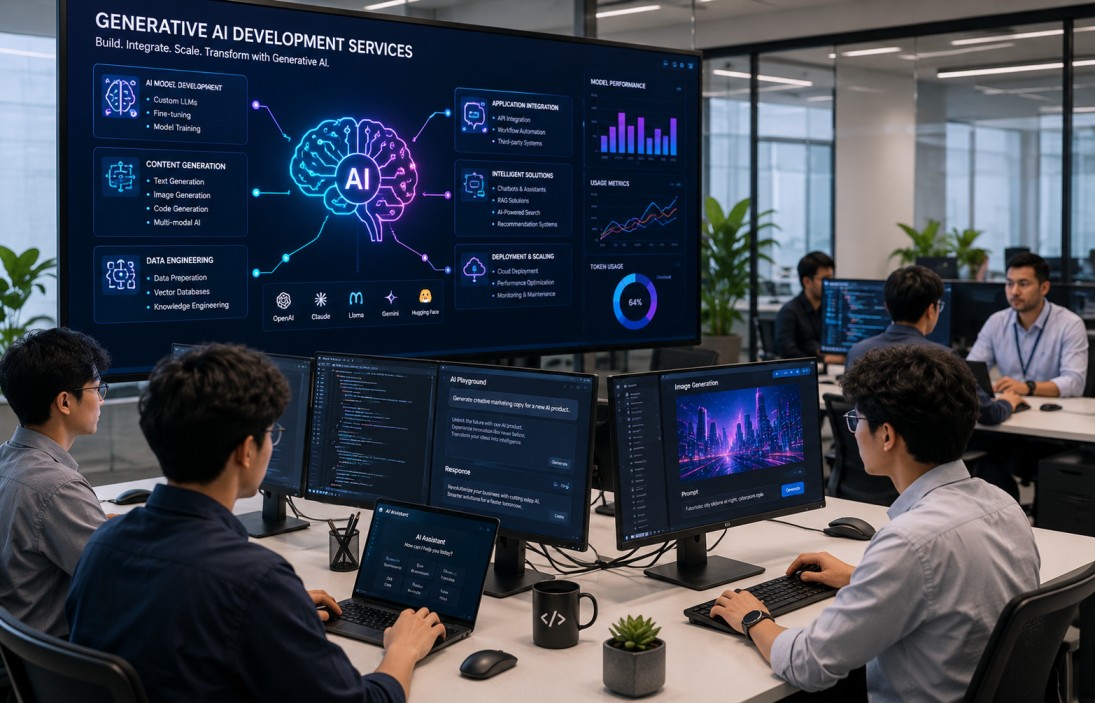
Generative AI has moved beyond experimentation and into business operations. Organizations across the United States are using generative AI to automate knowledge-intensive work, improve customer experiences, accelerate software development, and make organizational information easier to access. In 2025, McKinsey reported that 79% of surveyed organizations were regularly using generative AI in at least one business function, highlighting how quickly the technology is moving into everyday business processes.
However, adopting a public AI tool and building a production-ready generative AI application are very different. Enterprise AI solutions need to work with existing applications, business data, APIs, workflows, security policies, and compliance requirements. This is where Generative AI Development Services become valuable.
A well-designed generative AI solution can combine large language models (LLMs), retrieval-augmented generation (RAG), AI agents, enterprise data, automation workflows, and secure integrations to solve specific business problems. The objective is not simply to add AI to an organization, but to create intelligent systems that deliver measurable business value and scale with changing requirements.
Businesses are managing growing volumes of documents, emails, customer conversations, technical information, reports, code, and operational data. Traditional systems can store this information, but employees may still spend significant time searching, interpreting, summarizing, and transforming it.
Generative AI changes this interaction by allowing users to work with information through natural language while automating tasks that previously required manual effort.
McKinsey’s 2025 research found that generative AI use had expanded across business functions, particularly in areas such as marketing and sales, product and service development, service operations, software engineering, and IT.
Businesses are increasingly exploring generative AI for:
The important shift is from asking “Can we use generative AI?” to asking “Where can generative AI create measurable business value?”
Generative AI Development Services involve designing, developing, integrating, deploying, and optimizing applications that use generative AI models to create or transform content such as text, code, summaries, responses, documents, images, or other digital outputs.
Depending on the business requirement, development can involve:
Rather than treating generative AI as a standalone feature, organizations can integrate it directly into their existing digital ecosystem.
Generic AI tools can be useful for experimentation, but enterprises often need solutions designed around their own data, workflows, users, and technology infrastructure.
A custom generative AI application can connect AI capabilities with business systems such as:
For example, a company could build an internal AI assistant that retrieves information from approved corporate documents, summarizes relevant policies, and provides answers through a conversational interface.
This approach allows businesses to define how AI accesses information, what users can do, and where human approval is required.
One of the most practical applications of generative AI is helping employees find and understand organizational knowledge.
Enterprise information is often distributed across PDFs, documents, databases, emails, knowledge bases, and internal applications. Searching these sources manually can be slow and inefficient.
Retrieval-augmented generation, commonly called RAG, can connect an LLM with approved enterprise information. Instead of relying only on information contained within a model, a RAG application retrieves relevant information from a controlled knowledge source and uses that context to generate a response.
A business knowledge assistant can therefore help employees:
RAG solutions should also incorporate appropriate access controls so that users only retrieve information they are authorized to access.
Generative AI development is also expanding from conversational interfaces toward AI agents capable of supporting multi-step workflows.
An AI agent can be designed to interpret a request, retrieve information, interact with approved systems, perform defined actions, and return a result.
For example, an enterprise workflow could allow an AI agent to:
Agentic workflows require careful design because giving AI access to business systems introduces additional security, authorization, monitoring, and reliability considerations.
For high-impact workflows, organizations should define clear boundaries between automated actions and human approvals.
Generative AI can automate tasks that require understanding language, documents, and context rather than simply following fixed rules.
Businesses can use AI-powered automation to:
The greatest opportunity often comes from combining generative AI with conventional automation.
For example, traditional workflow automation can handle predictable system actions, while generative AI can interpret unstructured information. Together, they can create more flexible intelligent workflows.
Selecting an AI model is only one part of building a production-ready generative AI application.
A reliable architecture may include:
User Interface → Application Layer → AI Orchestration → LLM → Retrieval/Data Layer → Business Systems
Depending on the use case, additional components may include:
Organizations may also need to evaluate different models based on performance, cost, latency, context requirements, security, and deployment options.
This architectural approach helps businesses build AI systems that can evolve as models and business requirements change.
Enterprise generative AI cannot be treated as an ordinary software feature when applications interact with sensitive business information.
Security and governance should be considered throughout the AI development lifecycle.
Important considerations include:
NIST’s Generative AI Profile provides organizations with guidance for identifying and managing risks associated with generative AI across the AI lifecycle.
Responsible AI should therefore be incorporated into architecture, development, testing, deployment, and ongoing optimization rather than treated as a final-stage requirement.
Generative AI applications vary significantly by industry. The most effective solutions are designed around the workflows, data, regulations, and customer expectations of each sector.
Healthcare organizations can explore generative AI for:
Because healthcare involves sensitive information and high-impact decisions, appropriate security, validation, governance, and human oversight are essential.
Financial organizations can use generative AI for:
AI systems in financial environments should be designed with strong controls around sensitive information, permissions, accuracy, and auditability.
Retail businesses can apply generative AI to:
AI can help retailers create more responsive digital experiences while reducing repetitive content and support workloads.
Manufacturers can use generative AI for:
Connecting AI with trusted technical documentation can make critical information easier for employees to access.
Generative AI can support logistics organizations through:
The technology can help teams process large amounts of operational information while keeping human decision-makers involved in critical workflows.
Successful AI implementation requires more than selecting an LLM and building a chatbot.
A structured implementation approach can include seven stages.
Start with business problems rather than technology.
Evaluate processes based on:
AI applications are only as useful as the information they can securely access.
Organizations should identify relevant data sources, establish permissions, improve data quality, and define governance requirements.
Choose models and technologies based on the actual requirements of the application.
This may include:
AI should fit into existing workflows rather than create another disconnected application.
Secure APIs and system integrations can connect generative AI applications with enterprise software and data.
AI applications need evaluation beyond conventional software testing.
Teams should measure:
Production deployment should include authentication, authorization, monitoring, logging, rate controls, and appropriate human oversight.
AI applications require ongoing improvement as models, data, user expectations, and business processes change.
Continuous monitoring can identify opportunities to improve prompts, retrieval, model selection, workflows, and overall application performance.
AI investment should be connected to measurable business outcomes.
Depending on the application, organizations can evaluate:
McKinsey’s research indicates that organizations are increasingly reporting financial impact from generative AI, although many reported gains remain relatively modest and companies are still working toward broader scale.
This reinforces an important principle: successful AI implementation should be measured through business outcomes, not simply the number of AI features deployed.
Adding AI to a business process does not automatically create value.
The strongest implementations connect:
Business objectives + quality data + AI models + secure architecture + workflow integration + human oversight + measurable outcomes
This is why organizations should evaluate generative AI development partners based on more than their ability to create chatbots.
A capable development partner should understand:
The goal is to create an AI foundation that can support both today’s use cases and tomorrow’s business requirements.
Zoondia supports businesses seeking to integrate artificial intelligence into their digital operations through customized technology solutions and AI development capabilities.
A generative AI development engagement can be structured around the organization’s specific business objectives, existing systems, data environment, and scalability requirements.
From AI-powered assistants and intelligent automation to enterprise knowledge applications and AI-integrated software solutions, the focus should remain on building practical systems that can operate within real business environments.
Organizations can benefit from an approach that connects AI capabilities with existing digital infrastructure rather than treating generative AI as an isolated tool.
Generative AI is moving from isolated experimentation toward broader operational integration. McKinsey’s 2025 research reported that 79% of respondents said their organizations were regularly using generative AI in at least one business function, while only a small share reported that AI had been fully scaled across their organizations.
This gap creates an important opportunity.
The next stage of enterprise AI will not simply be about having access to powerful models. It will be about building the infrastructure, workflows, governance, and applications required to use those models reliably at scale.
Businesses that identify high-value use cases, prepare their data, integrate AI with existing systems, establish responsible AI practices, and continuously measure outcomes can build a stronger foundation for long-term digital growth.
Generative AI is changing how businesses create content, process information, support customers, develop software, and manage organizational knowledge.
But successful adoption requires more than connecting an application to an LLM. Businesses need secure architectures, reliable data, intelligent workflows, effective integrations, responsible AI practices, and measurable business objectives.
Generative AI Development Services can provide the technical foundation for building these capabilities through custom applications, RAG-powered knowledge systems, AI agents, intelligent automation, LLM integrations, and enterprise AI solutions.
For US businesses, the opportunity is no longer simply to experiment with generative AI. It is to identify where AI can create measurable value and build scalable systems that turn that opportunity into sustainable business impact.
Generative AI Development Services involve designing, developing, integrating, deploying, and optimizing AI applications that generate or transform content such as text, code, summaries, documents, images, and responses. These services can also include RAG, AI agents, LLM integration, workflow automation, and enterprise AI applications.
Generative AI can automate knowledge-based work, accelerate content and software development, improve customer support, simplify information retrieval, assist employees, generate business documents, and support intelligent workflow automation.
Traditional AI is often designed for tasks such as classification, prediction, recommendation, or detection. Generative AI can create new content such as text, code, images, summaries, and responses based on learned patterns and provided context.
Retrieval-augmented generation, or RAG, connects a generative AI model with external information sources. The system retrieves relevant information and provides it as context to the model, helping the application generate responses based on approved business knowledge.
AI agents are AI-powered systems designed to perform multi-step tasks by interpreting instructions, retrieving information, using approved tools or systems, and taking defined actions. Enterprise agents should operate within carefully designed permissions and governance controls.